Stephen's quest to retrieve all those forgotten houses
Reproduced from WESTERN MORNING NEWS, SATURDAY JANUARY 8 2011. WESTCOUNTRY LIFE
Janet King meets a historian who has carried out his own country house rescue
Walking around a centuries-old country house with an architectural historian whose current grand passion is for early decorative plasterwork
circa 1600 is not, perhaps, everyone's idea of a fun afternoon. But when the house is the historian's own and the man in question is Stephen Tyrrell, the
expedition is not just informative but also a joy, because this 64-year-old specialist in old buildings and restoration work has a sense of humour that's as
dry as rampaging rot.
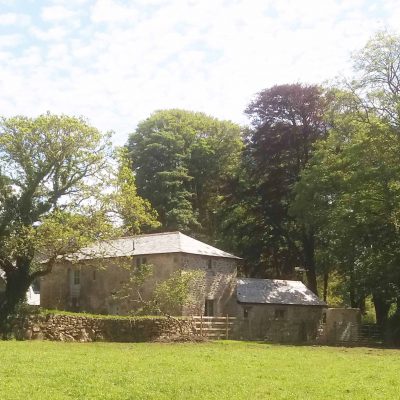
Which is lucky, actually, because with the amount of money he and his wife Kate have sunk into Bosvathick House - a Grade II-listed Georgian
house with Victorian wing added, set in about 400 acres at Constantine , near Falmouth in Cornwall - he certainly needs one. "This used to be a big
estate, but my predecessor believed that betting on greyhounds was a sensible method of investment' says Stephen ruefully, as he shows me around
Bosvathick, which has been in his wife's family since 1760 and which she inherited about 25 years ago. "Between 1950 and 1983, about 12 farms were lost.
So when we moved in, the first thing we had to do was spend lots of time and lots of money on a lot of houses - about 20 of them - as nothing had been done
in years."
"Every penny we've got has been put into renovating all the houses here. I bought all the tenants out, and every year did a house. And
it's broken me. I'm now poor! Sadly! In - the - gutter!" The last part is shouted with slow, melodramatic effect into my tape recorder, just to make
sure I've got the message.
They also had to install electricity in 1987 - and mains water, too. They still have the old well. But no gas. "No gas - hate
gas!!!" he shouts into my microphone, bending down low so his words can't escape the machine. Why does he hate gas? "Have you ever tried to deal
with the gas board?!" he bellows, before we all collapse into laughter, and in his case - nearly - tears. Plainly, it is still a sore point.
A specialist in old buildings and restoration work, Stephen Tyrrell is widely known as an expert in listed buildings. He certainly knows a
lot about many of the great houses of Cornwall , because he has worked on most of them. He has also written about, or edited, several books about them - his
latest tome, a 260-page epic on Caerhays Castle, near St Austell, which he has co-authored and edited, is due out later this year; it will be followed next
year by a fascinating in-depth work on the Early Decorative Plasterwork of Cornwall, 1550-1670, which will have 'over 400 colour photographs
of Cornish houses and interiors from small farmhouses to great houses such as Trerice and Lanhydrock'.
This is a man who plainly not only knows his stuff, but is passionate about it. Last year, he published a book about 17th century Pentillie
Castle, which overlooks the Tamar near Saltash; he has also published volumes on Harlyn House and the Earl of St German's estate at Port Eliot; another, on
18th century Boconnoc, near Lostwithiel, is in the pipeline. A lot of his book subjects have been - and still are - clients of his. In fact, Stephen sometimes
feels he is trailing in the wake of hotelier Ruth Watson, who presented the TV series Country House Rescue. For not only has he had to turn his own
country house fortunes around (by doing up houses, writing books, letting out cottages) he has also given advice to some of her TV subjects. "I have
definitely followed in her footsteps,' he says. "Three of the families shown have been clients of mine."
"By and large, I've disagreed with every piece of advice Ruth has given... she's on the ball, but you've got to remember she's making a TV
programme. My advice is usually'don't do it." Why not? "Well, for instance, I would want to make sure... is the client the right sort of person to
do this? Will they really make money at it? I can't give you any examples, because it's all privileged... but people usually call me in, say, to get planning
permission, or because I tend to find a simpler or cheaper way to do what they want. I quite often get involved in inheritance tax issues.'
Pentillie Castle , with 255 acres of gardens and parkland overlooking the Tamar near St Mellion in Cornwall , was one of those visited by
Ruth Watson in the first series of the Channel 4 programme, and broadcast in January 2009. Today, its website offers a helpful link through to buy Stephen's
book, Pentillie Castle , A 17th century family house above the River Tamar (£9.95 from Pasticcio Ltd, at Bosvathick).
As we wander around Bosvathick, Stephen's obsessive fascination with old buildings becomes ever more apparent. "When I watch films, I
watch the buildings, not the characters" he admits as we enter the section of the house that was once the old servants' quarters. "Does that make
sense to you?' Frankly, it doesn't, but I don't really have time to answer as, before I can say 'Upstairs, Downstairs', we're inside one of the bedrooms,
he's grabbing my hand and ordering me to stretch out the other and touch the wall... which is, of course, a very quick and easy way of measuring the width
of a room. Why? "Ah well, you see, the servants were allocated rooms in order of importance, with the biggest room given to, well, I suppose the butler,
then the housekeeper, and so on down... ' he cries, as he whisks me down the corridor from room to room and so I can see for myself that yes, indeed,
the rooms do become smaller. I know that because we 'measured' them. Stephen beams. Quod erat demonstrandum.
Sadly, today there is no sign of any butler or housekeeper at Bosvathick, although I'm hopeful of spotting a Mr Hudson or a Mrs Bridges
around every corner. His obsession probably stems from his childhood. "My father had a series of old buildings, and I spent most of my time looking at
them' he recalls. "We moved three times in my first 20 years - one of them is now a place where people go to sort themselves out, you know, that
place, I think it's called The Priory.' Stephen's father, Brinsley James Smyth-Tyrrell ("we don't use the double barrel') was born in
Northern Ireland, and plainly had a bit of money, as young Tyrrell was sent away to school (Winchester College, which now costs £30,000 a year to
board).
This delighted Stephen, as that meant plenty of interesting buildings. Sadly, his mother died of cancer when Stephen was just 12. "My
father went a bit funny after her death,' he says, matter-of-factly. "I was away at school. He burnt all her paintings and papers. Terribly sad.
But you don't want to go into that, do you? You'd have me on a psychiatrist's couch.' He then went to Trinity College, Cambridge, where he read English,
and was able to enjoy yet more ancient buildings and architecture. One of the highlights was holding tea parties every Thursday in a blatant ruse to encourage girls. "It was open house, but friends could only come in they brought a girl' he says. "There were only three girls' colleges at the time. We spent most of our time fantasizing about women.'
His father wanted him to be an accountant, but apparently he'd already spent a year doing that before going to Cambridge , and hated it. So
he went off to Canada to make his fortune. And did he? "No." He did, however, return and "spent 11 years working for biggish companies,
including banks'. He got involved in finance, international trade deals, and then, finally, building design and services, eventually winning a number of
design awards in the 1980s.
He did not meet Kate - or Beaujolois Katharine Cavendish, to be precise - until his thirties. Basically, he stole her from his best friend -
or rescued her, as he prefers to put it. "Well, he'd double-booked' he protests, when I begin to label him a cad. "He asked me to take Kate
out for him. But I already had a date, so I took both of them out... the other girl never spoke to me again.' Stephen and Kate were married in
Constantine Church in 1978, and today have three children - Eleanor, Philip and Josephine, all now married. Both Kate and Josephine, who lives nearby with
her husband, are involved with a local church, which Stephen describes as 'happy-clappy'. Stephen himself is more interested in church music ("always a
very big part of my life').
When Kate and Stephen finally took ownership (which was a gradual process) of Bosvathick, they immediately set to, carrying out their very
own country house rescue. "I consider it my life's work here to make it survive,' says Stephen. But it is more likely to be Kate herself who does
the serving these days, as the couple offer bed and breakfast at Bosvathick, at £40 a night to paying guests. "This is a real home, complete with
ancestral portraits, dogs, cats, silverware, dark hallways and first editions,' wrote one appreciative guest. "Dear Kate made us feel so welcome,
fetching chairs for us to sit in the sun, cooling our cava, even driving us to pubs and restaurants every night, and picking us up as well! Excellent
breakfasts, and an immense feeling of belonging after just one night. An absolute gem in a very 'real' part of Cornwall.' Kate is happy to do such
menial tasks. "I enjoy it - I wouldn't do it otherwise,' she tells me when we meet briefly in Stephen's study in the old stables later. 'We rattle
around a bit; a house like this needs children and people."
Besides his book publishing and consultancy work, and role as B & B host, Stephen also has another string to his bow... he and Kate run
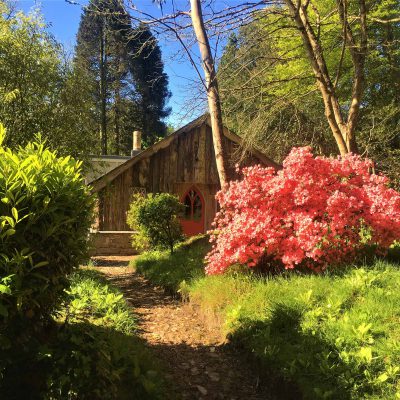
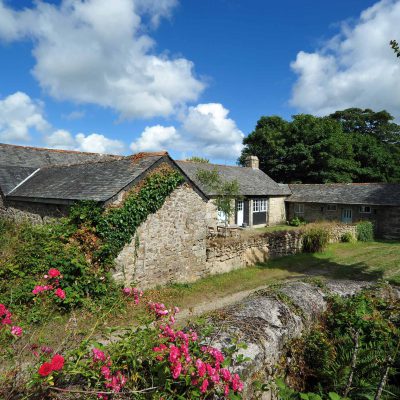
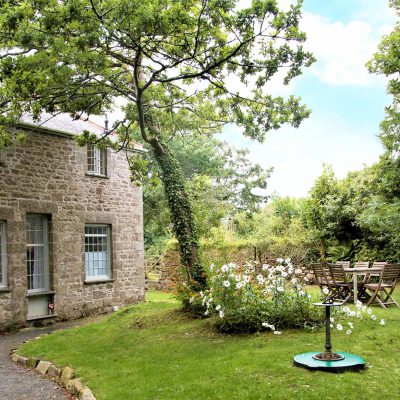
a holiday home lettings agency, called Forgotten Houses, from Bosvathick. Being the quirky character that he is, he is constantly on the look-out for
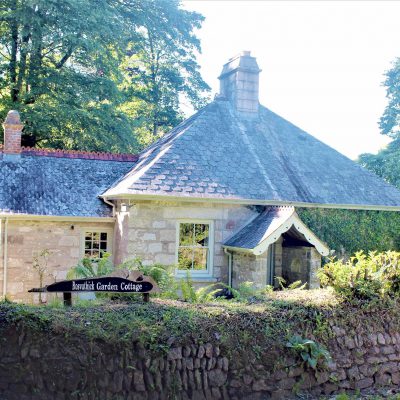
interesting, quirky buildings to add to his already growing portfolio. All the cottages he lets (many for clients whose cottages he has renovated; some are
his own) have bags of character: one of the most popular properties has an outside loo. "I wanted to have a niche company,' he says. "When I
looked at all the holiday companies, I couldn't tell them apart. They all had 'Cornwall Cottages' or something like that in the name. So I thought we'll have
something different; we'll only do interesting buildings. And we'll give architectural plans with each building, to make it even more interesting.'
Among the properties featured in Forgotten Houses (for which Stephen draws all original sketches for the brochure and website) are houses
in Wales, Ireland and France, as well as Cornwall . Stephen also now wants to expand these locations into Devon . Among them - and one of the most popular,
due to its Daphne du Maurier connection - is The Gamekeeper's House, at Menabilly, near Fowey. Renovated in the 1990s, it is just 500 yards from a beautiful
beach and inlet; it costs up to £1,029 a week. The one with the outside loo is Mellinzeath, a romantic thatched cottage in a secluded wooded valley, by
the Helford River (it sleeps five, and costs up to £595 per week). It has no TV reception, no washing machine, no freezer, and a normal car can't get
within 600 metres of it. "Honeymooners love it" says Stephen, who advises guests to "bring rubber boots". At the other end of the scale, one of the most expensive, at up to £3,630 a week, is Coswyn Barn, which sleeps 14, on the outskirts of Hayle. There are also cottages on the estate at Boconnoc, a grand 18th century house near Lostwithiel, where Stephen himself has been involved in a lot of renovation work.
Ever keen to lighten the subject, Stephen says he likes to vet his holiday cottage guests before they arrive. "We don't like doctors, they
make Afghanistani terrorists look easy," he jokes (I think). "Nor do we like people from Yorkshire , they spend all their time hoovering. But top
of the list are unmarried, divorced women who go away in two families... no-one's in charge, no-one cleans up, and they can't really afford it after the
divorce..." Luckily, either Kate or their assistant, Helen, usually manage to speak to the guests first. Meanwhile, prospective holidaymakers
might like to contemplate some of Stephen's helpful suggestions of 'things to think about' before making their trip:
■ Keep your Wellington boots ever by you, but do not wear them in bed.
■ Don't make a resolution or give up something just before or while on holiday. Bad temper is not helpful to holiday atmosphere.
■ Never go swimming - it is impossible to hide your possessions.
■ A house is not a home without an onion.
And finally, he issues this health warning: "An apparently happy visitor has been taking a 1500-metre run up and down a steep rough
track, adding an extra circuit for each day of the holiday. Thank heavens he was not here a fortnight. His wife said he seemed a bit tired, and slept a
lot..." We emphasise that we are not responsible for shortness of breath, palpitations, spousal complaint, or athlete's foot... 'Quirky cottage
company, quirky owner. You have been warned... "
|